the worshipful company of chartered architects

this web-log is an active extension of the 98th City of London Livery Company's web site at http://www.architects-livery-company.org/

Tuesday, 1 December 2009

...and with the Master away in York

Each year the Company's Charitable Trust supports the TeamBuild competition run by the Institution of Civil Engineers with the support of both the Chartered Architects' and Constructors' Companies. This weekend event which started in the early 1990's continues to evolve but sticks to the original intent of encouraging teamwork within multi-disciplinary groups of building professionals. The Company gives a prize for the team offering the Best Construction Procurement Strategy.

The Company was represented this year by Ronnie Murning an Assistant on the Court and an experienced project manager. Ronnie's take on the event was:

'It was a memorable weekend. Team Build is an incredibly well rounded concept that has matured into an event that is in my opinion is very very special. It really does deserve the Company's unswerving support for the future.

I also ..... discussed broadening the naming of the WCofCA prize to procurement and construction. The organizers were supportive of the suggestion and will hopefully raise the matter for discussion at the next committee meeting.

The logic is that it would be then consistent in that the WCofConstructors gave the design prize and we gave the procurement and construction prize covering the whole spectrum of a project from inception to completion.

 
With the inclusion of the construction element, which is a discrete activity within the weekend's overall programme, it is complementary and in balance with the design prize. It also reinforces the teamwork connection as the Constructors give the design prize and the Architects give the procurement and construction prize.'


A visit to York


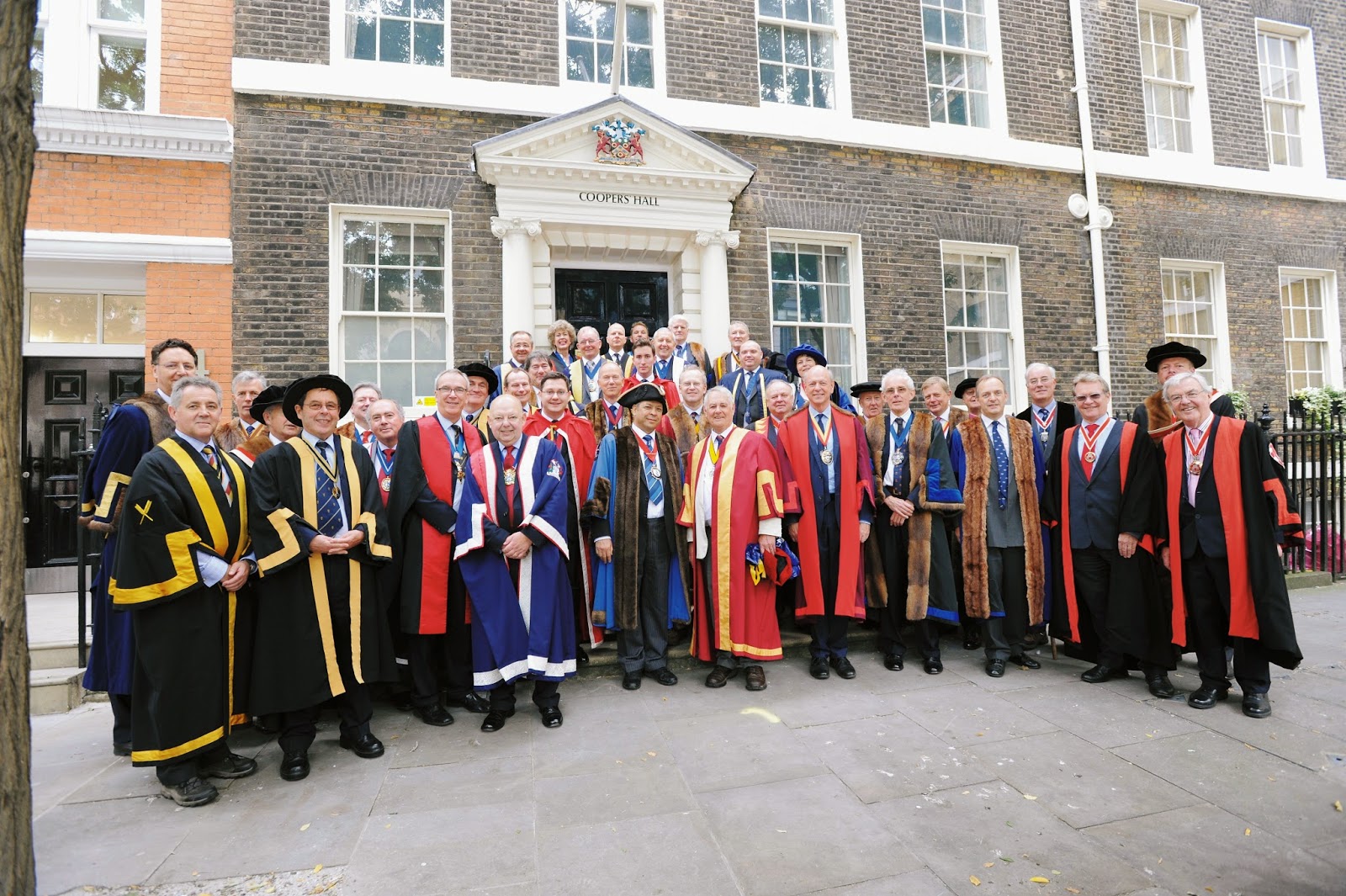
It has become something of a custom for the Master to dust off his passport for the annual pilgrimage to attend the Annual Dinner of the York Guild of Building. This year he was accompanied by the Upper and Junior Wardens and a selection of Past Masters and other Chartered Architects. The dinner was held in the splendid Merchant Adventurers' Hall on Thursday 19 November.  


As may be seen from the photograph above, the Master and Upper Warden were in good and colourful company.


Many members of the travelling party made a weekend of it by staying of for a bit of sightseeing and the Guild's Annual Service at All Saints Church to which the Master and Upper  Warden processed from the Guiild's base in Bedern Hall


In keeping with local tradition, festivities were concluded with a sherry, fruitcake and cheese reception back at the Hall

Thursday, 26 November 2009

Night falls on Temple Bar 17 September 2009


*** thanks to Michael Wilkey ***

Wednesday, 11 November 2009

The Master's reception at the church of St. Stephen Walbrook


The reception was held on Tuesday 10 November in the Lord Mayor’s parish church of St. Stephen Walbrook : the finest Wren neo-classical church in the City of London, it is considered by some to be his finest and a forerunner for the design of St. Paul's.

Those attending were welcomed by the Master and given a very interesting talk on the church and the theological reasons for its original and current existence by the venerable Peter Delaney MBE – the priest in charge.

The church was constructed from 1672 to 1680, built of stone and rubble, at a cost of £9,412 12 shillings and 8 pence. Wren received the sum of 20 guineas for his design (at something less than 0.25% he was probably lucky that the RIBA had not yet been formed and that he had other sources of income). The circular plaster dome sits on 12 columns (with Corinthian capitals) that are set in a square. The transition from square to dome has been cleverly done.

The Henry Moore Travertine Altar donated by Lord Palumbo, weighing 8 tons was delivered into the church in 1978 through a window during a refurbishment of the interior. Though it proved to be very controversial, its existence survived appeals to several ecclesiastical courts and continues to be both used and a subject of strong opinions to this day. The candlesticks are by Hans Coper and the altar kneelers by Patrick Heron. The Victorian pews were removed in 1888. The church has a seventeenth century triple-decker pulpit.

Chad Varah (1911-2007), then Rector of St. Stephen Walbrook formed the Samaritans from this church in 1953 and the telephone that was used for the “999 service for suicides” is displayed in the church today. Tel.No.MAN(sion House) 9000.


Among those who are buried in the church are Sir John Vanburgh, Robert De Courcey Laffan who with Baron Pierre de Courbetin formed the modern Olympic movement, and John Durham, a musician of the 15th century. The members of the Company and their guests enjoyed a glass of wine and canapés after the talk and Peter Delaney joined in the discussions about the style, furniture, art and architecture of the church.

St. Stephen Walbrook is the London Internet Church .
thanks to Michael Wilkey for this post

***

Friday, 6 November 2009

A visit to the Palace of Westminster - 'Mother of Parliaments'

Autumn leaves were already falling around Westminster Abbey when Company members gathered to meet their host, Lord Naseby, and their guide, Adam Watrobski, for a special visit to the Palace of Westminster, commonly called the Houses of Parliament.

When built it was the largest public building in the world, and was at the cutting edge of technological development. To demonstrate this, our guide took us into several places off the tourist track. Firstly we saw inside the roof space, where we could see the cast iron roof tiles and supports. The tiles are in dire need of attention - they all have to be taken away for sandblasting and treatment before replacement. Following the fire that destroyed the original palace, the Victorians were meticulous about avoiding the use of combustible materials in the structure.

Then we were taken some hundred steps up to the great lantern that originally served as the principal ventilating element in the complex. Stone on the outside and brick on the inside, it has within its base a restraining chain, rather like that in the dome of St Paul’s Cathedral. Gaunt and grimy on the inside it belies its elegant exterior. It sits on top of the grand central lobby that can often be seen on television.

Issues surrounding the conservation of worn out floor tiles, inaccessible statuary and decaying stonework were the subject of thorough coverage by our guide; only occasionally did we cross the paths of groups during the generalist tour of the premises.

The two hour visit had generated a need for sustenance (photo above of Master and Upper warden and Lady in clear need of such), and this was amply satisfied by a buffet supper at the National Liberal Club built in 1885-87 to the designs of Alfred Waterhouse in conjunction with the architects responsible for the adjoining gothic confection, Whitehall Court. Moving towards the ‘Lady Violet’ (Bonham-Carter) Room we passed by the portraits of the fin de siècle grandees of Liberal England set in the context of Waterhouse’s magnificent building.

Lord and Lady Naseby had seemingly little difficulty in overcoming any problem of party affiliation in these surroundings joining with us all in a jovial end to the day. Many thanks to him and to Adam Watrobski for opening our eyes to the architectural problems associated with keeping the fabric and architectural character of this marvel of Victorian architecture in good repair.

Monday, 2 November 2009

New plaque in New Street Square


The Lord Mayor of London - The Rt Hon Alderman Ian Luder was on parade in New Street Square on Tuesday 27 October to unveil the plaque which records the success of the development in winning the Company's New City Architecture Award for 2008.


The Master - Roger France - welcomed the Lord Mayor and other guests at the ceremony and the Lord Mayor thanked all those who had been involved in the development for bringing such a vast improvement to this particular corner of the ward he represents as an Alderman. He particularly welcomed a development which had delivered not just a considerable architectural statement but also a very successful public open space served by retail outlets and catering establishments. He had been pleased to learn that those using the square during the summer months had been able to enjoy the pleasure of seeing England reagin the Ashes on the giant television screen kindly put in place by the landlords. In his comments on the desirability of good public open spaces he noted that, among the entries for the Awards had been a number of open space schemes. One of these - the south Garden at St Paul's Cathedral, had been a strong contender for the award and that this had also been pushed by a strong set of entries from the Corporation's Street Scene team.

He welcomed the involvement of developers Land securities in the scheme and drew attention to their New Change development which, he was confident, would be a contender for the award in the near future.


Seen left are the Master, Architect Rab Bennetts, the Lord Mayor, Land securites Director Jonathan Evans and the Clerk.


Pictured below are Past Masters Deputy Michael Welbank and Ian Head and Rosemary Curry in conversation with the Lord Mayor and Swordbearer and Senior Programme Officer at the Mansion House,
Lt Col Richard Martin.

Happily, the weather remained fine for the occasion and all present were grateful to Land securities for their hospitality in the splendid Marketing Suite which overlooks the new square.

Applications are currently sought for entires for the 2009 New City Architecture Award. These will be welcomed from schemes completed free of town planning conditions in the year ending 30 September 2009. Judging will take place early in the new year.

Tuesday, 22 September 2009

The Fate of London Bridge

The Master, Roger France, was grateful to the Rector of the Church of St Mary-at-Hill in the City for hosting not just an exhibition of all the entries submitted for the New Inhabited Bridge for London Ideas Competition but also for allowing us to stage a lecture - attended by over 100 people from the City and elsewhere given by Mark Latham pictured here with the Master - a doctoral student at the Centre of Urban Studies at the University of Leicester.

His sudies uncovered a tale of corruption, mismanagement, financial crisis and a property crash that resulted in the downfall of the Old London Bridge- the capital’s last ‘living bridge’ and provides a stark warning from history as London Mayor Boris Johnson ponders plans for a new ‘inhabited’ London Bridge – between Waterloo and Blackfriars – with luxury flats, shops and restaurants.

Mark discovered the houses built on the Old London Bridge to attract the gentry didn’t have the pulling power as expected. This combined with an economic slump and other factors to ensure that the grand vision of an inhabited bridge across the Thames was not sustainable.

“Old London Bridge is familiar to many of us in the form of the nursery rhyme “London Bridge is fallen down”, said Mr Latham, “but what is not generally known is why commerce and housing on the bridge did collapse.

“It was previously assumed by historians that the removal of the structures from the Bridge was part of a more general movement within the Corporation of London to “improve” the City via a series of infrastructure projects. However it is clear from my research that a far more complex and intriguing set of factors were at play.”

The removal of the houses and shops from Old London Bridge occurred in 1756. Mr Latham’s study has examined why.

He said: “I am fascinated by the question of why the houses were removed from the Bridge as in medieval times they were viewed as one of London’s great attractions, and the rental income from the houses on the Bridge, alongside others within the City of London, financed the maintenance of the structure.

“What I discovered was that the organisation that managed the bridge at that time was plagued with incompetent management and corruption. Both workmen and their managers charged inflated prices for materials and labour, the management left rents uncollected, and on several occasions the workmen were found to have deliberately and almost fatally damaged the Bridge in order to charge for its repair.

“Furthermore, managers often paid for improvements to their own houses out of the coffers of the Trust running the Bridge.”

Problems were compounded by a “highly risky, costly and poorly timed project” undertaken in the teeth of a credit crisis to construct a series of gentrified houses on the Bridge in the belief that such houses would prove attractive to middle class Londoners and increase the organisation’s rental income. However, the authorities had grossly miscalculated the demand for such properties and the houses attracted only a handful of tenants.

A London wide property crash ensued and soon the Trust was haemorrhaging income, the maintenance budget for the Bridge itself was being squeezed and so the vacant houses on the Bridge began to rapidly fall into a state of dangerous disrepair. London Bridge was indeed close to being “fallen down”, said Mr Latham.

“At this point reality dawned on the members of the Trust, and they faced up to the fact that it was no longer financially viable to maintain structures on the Bridge, and by the early 1755 they had begun to petition Parliament in a desperate plea for the money to fund their demolition.”

One further interesting insight from the study is that the removal of the houses and businesses from the Bridge marks a break from London’s medieval past.

Said Mr Latham: “The renovation of the Bridge in the mid eighteenth century was such an important event in the history of London as in many ways the demolition of these characterful medieval houses and the subsequent transformation of the Bridge into the type of bland utilitarian functional structure - very similar to the London Bridge we see today - represents a rupture with London’s medieval past and can be taken as symbolic of London’s emergent modernity.”

September 2009 Newsletter

September 09 Newsletter